Philippine government officials have delivered a stark warning to Meta’s leadership, threatening regulatory consequences unless the social media giant immediately strengthens its fight against disinformation spreading across Facebook and Instagram during the current global oil emergency.
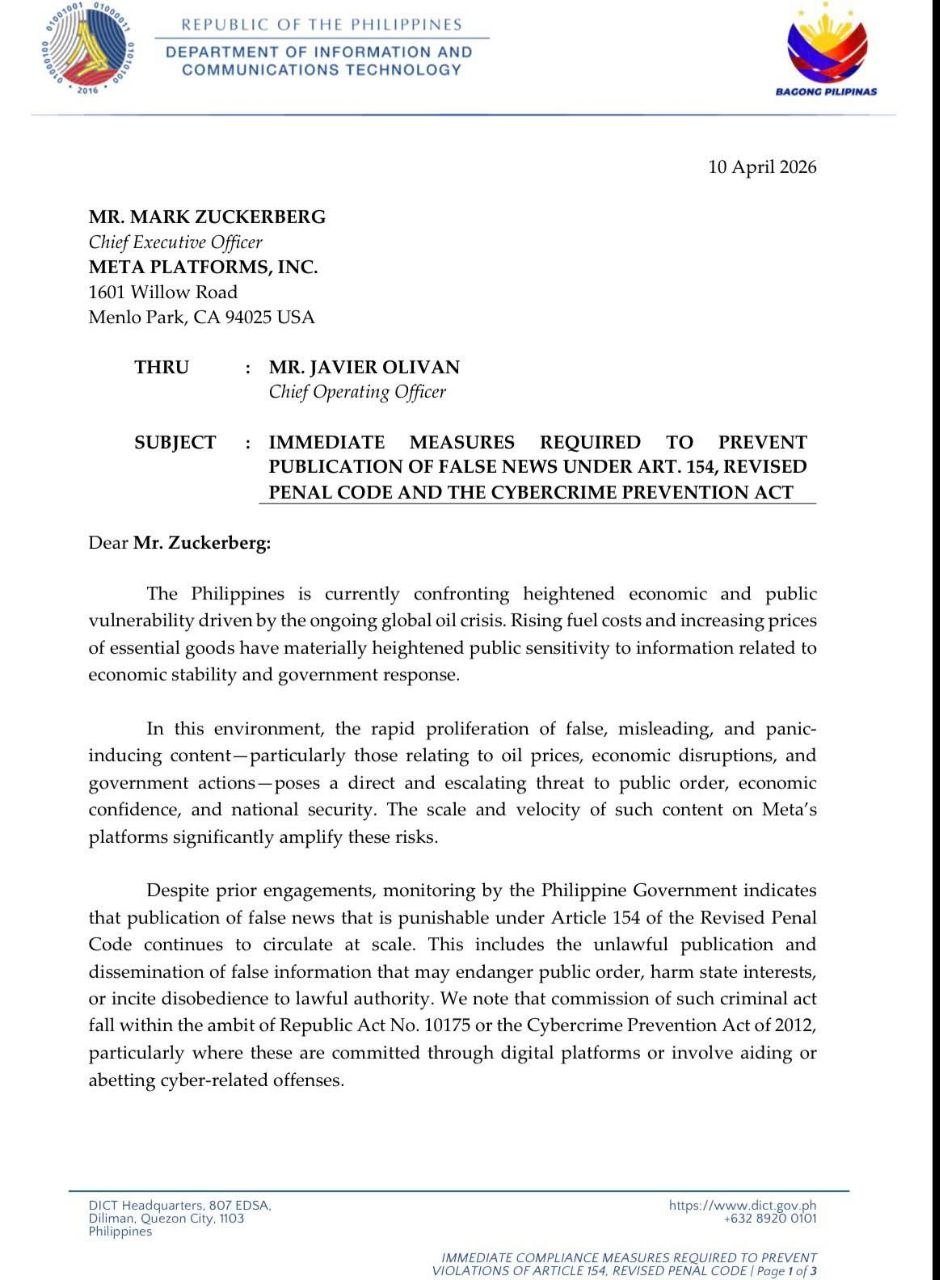
The formal communication, sent April 10, 2026, by DICT Secretary Henry R. Aguda alongside Acting Presidential Communications Office Secretary Dave M. Gomez, characterizes the unchecked flow of false information as presenting “a direct and escalating threat to public order, economic confidence, and national security” at a time when the nation faces significant economic pressures.
Officials emphasized that the current global energy crisis has created an environment where misleading content about fuel costs, supply disruptions, and official government responses could spark widespread panic and destabilize economic conditions. The letter notes that escalating fuel prices and rising costs for basic necessities have created “materially heightened public sensitivity” to economic-related information.
Strict Timeline Imposed for Compliance Response
The ultimatum establishes demanding deadlines for Meta’s response, requiring acknowledgment within 48 hours and a comprehensive implementation strategy within seven calendar days. Government officials cautioned that non-compliance would trigger “appropriate regulatory and legal measures” involving coordination between the National Telecommunications Commission, Cybercrime Investigation and Coordinating Center, and Department of Justice.
Legal foundations for potential enforcement action include Article 154 of the Revised Penal Code, which establishes criminal penalties for publishing false news, and Republic Act No. 10175, known as the Cybercrime Prevention Act of 2012. According to government monitoring, problematic content continues circulating “at scale” across Meta’s platforms despite previous collaborative efforts.
Priority Disinformation Categories Outlined
Government officials identified multiple categories of harmful content currently spreading that present elevated risks during the economic crisis. Among the most concerning are fabricated documents falsely claiming medical emergencies, incapacity, or death involving senior government leaders, particularly the nation’s President.
Misleading or exaggerated claims regarding fuel price increases, alleged disruptions to energy supplies, or unauthorized lockdown announcements capable of triggering panic and economic instability represent another critical area of concern. Officials noted such content could generate artificial market distortions and unnecessary supply chain disruptions.
Additional problematic content includes disinformation campaigns targeting banking institutions and digital payment platforms that could erode public confidence, fabricated statements attributed to law enforcement or military leadership, and narratives promoting resistance to legitimate government directives based on false information.
Coordinated inauthentic behavior specifically targeting government institutions and officials was also identified as requiring immediate intervention from Meta’s content oversight mechanisms.
Link to Potential Economic Violations
The government communication established connections between disinformation campaigns and possible economic crimes, arguing that malicious false information leading to public panic or artificial market distortions could facilitate violations of Republic Act No. 7581, commonly known as the Price Act, which targets hoarding, profiteering, and market manipulation practices.
Officials contended that misleading information regarding fuel availability, price projections, or economic policies could establish conditions enabling or encouraging illegal price manipulation by businesses attempting to capitalize on public anxiety and uncertainty.
Mandatory Platform Safeguards and Response Systems
Philippine authorities detailed specific enforcement measures they expect Meta to deploy without delay. These encompass enhanced automated detection and removal systems for high-risk disinformation, with particular focus on coordinated inauthentic behavior that could amplify false economic narratives.
An accelerated government reporting and content removal protocol featuring priority processing for material threatening public safety, economic stability, and national security was also mandated. Officials expect this framework to include well-defined escalation procedures and binding response timeframes for high-priority content categories.
Meta must additionally establish a senior-level, round-the-clock coordination contact to facilitate immediate engagement during urgent situations, enabling rapid response when false information about economic conditions or government actions gains widespread circulation.
Mandatory transparency reporting regarding enforcement actions targeting harmful content affecting the Philippines was included among required measures, establishing accountability for platform content moderation initiatives.
Economic Crisis Creates Amplified Risk Environment
The official communication stressed that the Philippines currently faces “heightened economic and public vulnerability” resulting from the continuing global oil crisis. This economic strain has generated conditions where false information can produce magnified effects on public trust and market stability.
Government representatives observed that the “scale and velocity” of misleading content across Meta’s platforms substantially increases risks to economic stability during this critical period. The rapid dissemination of misinformation through social media channels can reach extensive audiences before verification or corrections can be deployed effectively.
Enforcement Consequences and Agency Coordination
The government’s formal demand implies substantial regulatory intervention should Meta fail to implement requested measures. Multi-agency coordination involving the National Telecommunications Commission indicates potential enforcement responses could span from content limitations to operational restrictions.
Participation by the Cybercrime Investigation and Coordinating Center suggests possible criminal proceedings related to platform operator obligations in preventing illegal content distribution, while Department of Justice involvement indicates comprehensive legal approaches may be under development.
Nevertheless, officials stressed their preference for collaborative solutions, stating the Philippine Government “remains prepared to engage constructively” while insisting on “immediate, concrete, and verifiable action” given the critical nature of current economic circumstances.